I LOVE HER.
I LOVE HER.
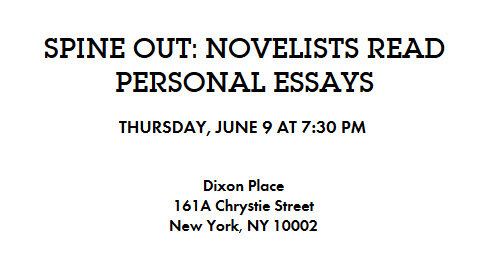
What an amazing thing! If you're in New York and want to come, here's an evite for you. Feel free to forward, invite, spread the news. I'd love to see you.


So, this happened last week:

And then I died and went to heaven. The end.
I spent the winter full of Library Tuesdays working on revising my second novel, THE BIRTHRIGHT OF PARKER CLEAVES, after realizing I hated it and it wasn't ready for query AT ALL. I ended up doing the usual cutting of 10,000 words and rearranged whole sections and considered dumping the entire thing because ohmygodIsuckatnovels.
It's a little short right now, but I'm at that point where I don't know what it needs to edge it into recommended length. And then there's that part of me that wonders why those rules even apply when so many people read books digitally and word count was probably made up by someone more looking for the sweet spot in printing costs rather than pondering how many words it takes to tell a good story. Then my mind goes into an existential crisis about the relevance of anyone's words long-term and it's time for a snack.
Last weekend while we were driving home from my MIL's house in Cedar Rapids, I elected to sit in the back seat, determined to make the final pass through my printed-out manuscript before I hand it off to a trusted reader. I didn't know what I'd find. Before I printed it, I moved so many sections around I wasn't sure if I'd need to write more connective tissue or what. It surprised me that so many scenes that I mushed together out of three or four little orphaned pieces chapters apart made any sense at all. Obviously I kept thinking she should really talk to her dad again more than once but didn't write enough in any one place to have a scene. This writing thing is stupid hard.
I've spent the past three years working on this novel. There are parts I really like, and then I'm certain if I read it in two weeks I'll actually hate it. I think right now there are maybe five good sentences in the whole damn thing. Tonight I'm going to the library to make the final corrections from the backseat and move a few more sections around, then I should let it steep for a few weeks before I read it again.
I don't know if I can bear to read it again.
But I don't trust myself to be even remotely right about anything when it comes to my writing these days. My daughter asked me if I liked revising, most likely catching a glimpse of my anguished expression in the rearview mirror. It's hard to explain. Do I like running, even when it hurts? Do I prefer to have run but hate the process? Writing is kind of like running.
I love it, I hate it, I'm ambivalent about it. Which means it's probably getting close to being done or thrown out.
Today I'm over on SheKnows.com talking about tattoos and parenting. Please come on over!
(Editor's Note: I met Bonnie years ago via the blogosphere and love her work. I hope you'll enjoy her post on body image and motherhood, and please check out her collaborative video project on The Shape of a Mother. - Rita)

When my daughter was born almost fourteen years ago, I was utterly unprepared for the extent of physical changes that would come along with the pregnancy. Afterwards, I felt torn between the awe and pride I should have been feeling for what my body did, and the shame I actually felt for looking nothing like the pictures I saw in magazines.
I assumed I was the only one dealing with this so I kept it to myself for a long time. And then one day, almost four years later, I happened to catch a glimpse of another mom’s belly and in that instant I knew this was actually a totally normal thing. It was such a relief to be able to let go of that self-hate I had spent so much time focused on and I wanted to make that knowledge available for women worldwide.
I wanted everyone – mothers, women who aren’t mothers, and men – to know mama bodies are normal. So I started The Shape of a Mother. It’s been just about a decade now and I’ve published the stories of about 2,500 moms in that time. Here are the top five things I’ve learned working with women and body image.

Working with SOAM has changed my life completely. It’s given me an unexpected career I never could have dreamed up on my own, and it’s taught me compassion, perspective, understanding, kindness, and how to be brave. I hope, in turn, I can share these gifts with the world.
October 17, 2015 - complete third half-marathon
December 18, 2015 - 5:56 pm - complete hour-long cross-training workout at the gym
December 18, 2015 - 11 pm - fall hard on ceramic tile in my kitchen
December 19, 2015 - diagnosed with broken fibula
January 6, 2016 - surgery to put plate and five screws
February 11, 2016 - surgeon clears me to start transitioning to weight-bearing on injured leg
February 12, 2016 - start physical therapy
March 7, 2016 - cleared to use nonimpact cardio machines other than stationary bike
March 11, 2016 - today
As I spent countless hours this winter lying in my recliner with my leg propped up on three pillows and wrapped in ice, I discovered A&E's Fit to Fat to Fit show. I have never watched The Biggest Loser, because I don't like the format very much. I never miss an episode of Fit to Fat to Fit, though, because I need to watch those personal trainers who gained hella weight return to the gym. I myself am returning to the gym, and it's hard.
I started working out when I was in high school and developing a pretty gnarly eating disorder. I've had to break the mental connection between calories in/calories out because if I do that I have a tendency to both overexercise and overeat. The brass ring that's so hard to catch is figuring out how to exercise the right amount without always tying it to weight loss.
For all of my adult life, I've been terrified of breaking a leg because it renders exercise almost impossible. I always assumed I would blow up like a blimp if I couldn't exercise. And that didn't happen. I did gain probably five to eight pounds, but it's hard to tell if that's because of the broken leg or because of winter. I do usually gain weight in winter and lose it in the spring, like a lot of people. Still, five to eight is a manageable amount and I know it will come off. I have gained and lost the same five to eight pounds over and over during my adulthood. What I haven't done is come back from immobility.
The least amount of exercise I've had since I was seventeen until I broke my leg: three times a week. Somehow, through all the business trips and vacations and illnesses and with the lone exception of the first six weeks after childbirth, I've worked out hard. And, I haven't not exercised this time -- I did floor barre and arm weights every weekday and crutched around as much as I could on the weekends. But that's not the same. I didn't break a sweat really until I started stationary biking when I could put weight on my injured leg.
According to my physical therapist, I'm still likely six weeks away from running.
And then once I can run, how far will I be able to make it? Not far.
I remember the first time I decided to run a half marathon. I could only run three miles. Every time I ran, I added a block.
I don't want to go through this again.
I don't want to fight back from nothing.
I've spent all winter making the tiniest incremental progress and it is so slow.
And so I love Fit to Fat to Fit, because the trainers who gain stupid weight in four months have that moment when they get back in the gym or out on the sandy beach and they're trying to run and it's so not happening. Then at the end of the show, there they are, looking more hard-bodied than I ever will (I have no intention of becoming a personal trainer, for one thing, and I'm at least ten years older than anyone who has been featured, for another). I don't want to be hard-bodied, but I want to get back to being able to run for an hour straight.
Right now, that seems impossible in my darkest hours and so far away in my lightest.
The one thing I can cling to is the memory of my husband saying, "Stop looking at them and comparing one to the other," when he caught me sniffing back tears as I studied my left calf and ankle and my right. My left calf looks like a runner's calf. My right calf, four weeks ago, looked like an uncooked piece of chicken. Zero definition, puffy, slack. Today, my right calf doesn't look like my left calf, but it no longer makes me reach for a crockpot.
I can do this, I know I can do this, but if watching twentysomething personal trainers grit their teeth and jiggle their new belly fat and try to hold a plank makes me feel better, then dammit, pass the remote. I won't apologize.
And I signed up for a 10k in September, six months from now.
"That's what I miss ..."
Once the pleasantries were over, that's what they kept returning to.
My girl and I were sitting in the booth behind them at Panera for two hours. My daughter had her headphones in, her attention buried in homework. All I had to do was busywork, so I did what I suspect every novelist does: I eavesdropped.
I couldn't see her and only the back of his head, his white hair carefully oiled and combed.
They talked about what they liked to do (movies, yes, bars, no), their past careers (both looked to be past 65), their families. How loved ones had died.
That's why she chose him on the dating website, she said. Because he'd been married a long time, and his wife had died. She thought that made him safer, that he's understand what she'd been through.
This was her first online date.
They both referred to "my husband" and "my wife" without irony or awkwardness. The part that crushed me and lifted me up was when they would be in the middle of a story and laugh and say, "You know, that's what I miss, laughing with someone." And the other would agree, and then they'd go on.
They went on for two hours and I kept glancing at the back of his head and being so happy for both of them, especially in the end when she asked him to please contact her again. They stood, and I finally saw them: her, a cheery looking white woman with bright lipstick and him, a tall white man with a plaid button-down shirt and skin that spoke of outside work. They hugged.
What courage it takes at any age to put ourselves out there, to meet someone new. With my husband traveling for work every week, I find myself vacillating between not leaving the house and making unnecessary and awkward conversation with strangers in public places.
My daughter finished her homework and my laptop battery died shortly after the older couple left, but I couldn't help but feel witnessing their encounter was the most important part of my day.
To be reminded, that in the end, what you miss about people is just the comfort of their steady presence looking out for you.
I went to see my doctors last Thursday. I was five weeksish post-surgery.
The resident is more conservative. He came in and said to keep all weight off until six weeks post-surgery, then take 2-3 weeks to transition to full weight-bearing with the boot. He left. I cried. I am so tired of crutches.
Then the surgeon came in. He said the X-ray looked fine, transition to full weight-bearing within a week, lose the boot after that, get some PT, come back in five weeks.
In other words, he left it up to me. I love you, Dr. Surgeon.
My husband is back to traveling for work 75%, so leaving it up to me gets very real very fast. Walking (or crutching) out of the doctor's office last week, I felt something I haven't felt since December: agency.
I'm ready to make my own decisions.
This broken leg has made me into a teenager again in all the worst ways. I can't choose when I leave the house. I have to ask someone to drive me somewhere. I can't go for a run or walk.
I've found myself retreating to headphones and NIN.
To have my current state of recovery in my own hands feels surreal. I decide when to stop using the crutches. When to transition to shoes. When to start physical therapy. These are important decisions if I want to run again, but to not feel infantilized is huge.
Today I put about 50-70% weight on my right foot while using one crutch and cleaning my house. My ankle is sore but fine.
My psyche is better than ever.
I feel like an adult again.
I can't stress enough how important that feels.